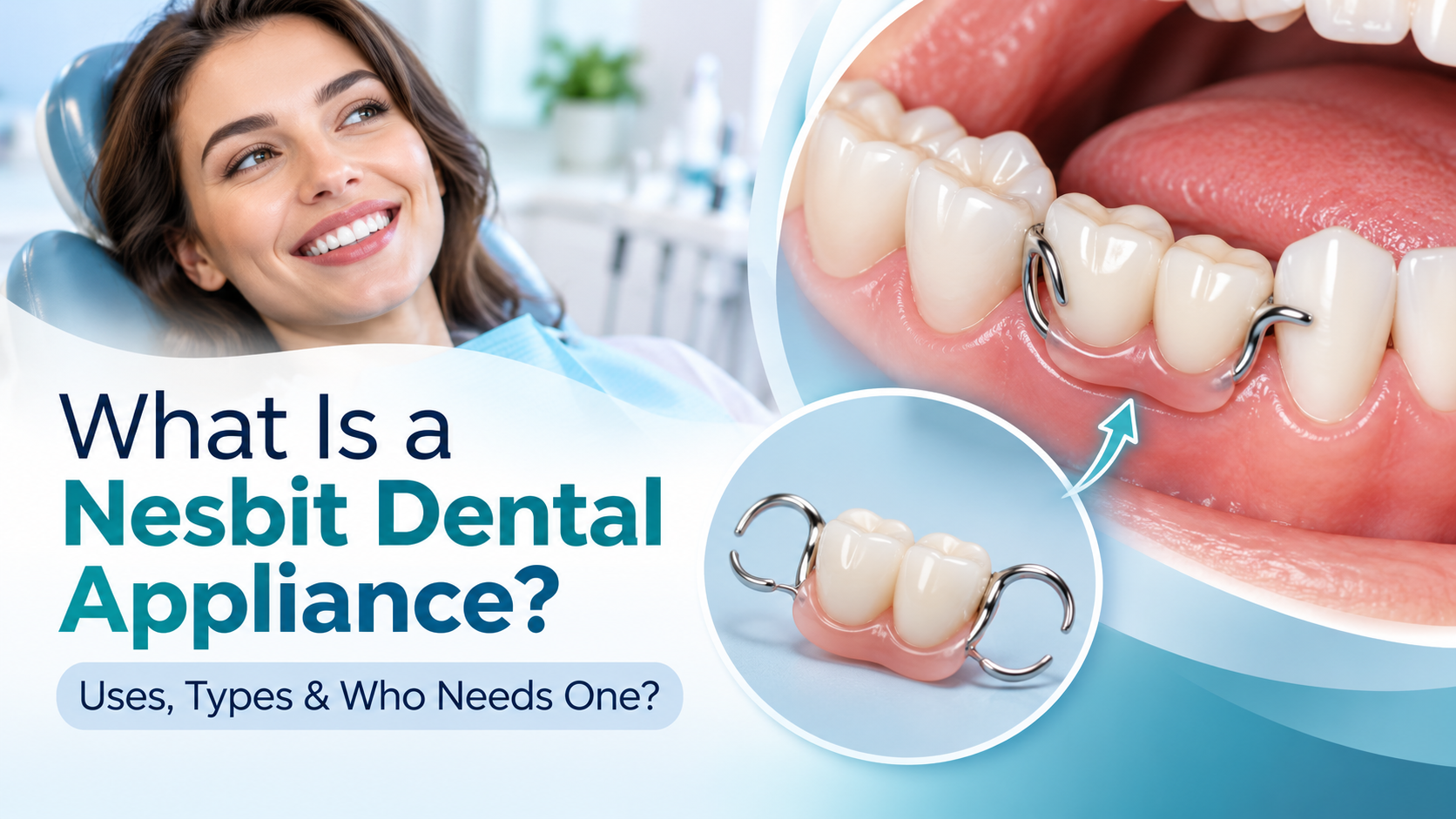
Losing a tooth can affect more than your smile. It may make chewing uncomfortable, change how you feel about your appearance, or leave you searching for a replacement that does not require extensive dental treatment. For people missing one or two teeth in a specific area, a Nesbit dental appliance may be an option worth discussing with a dentist.
A Nesbit appliance is a small, removable partial denture designed to replace one or a few missing teeth on one side of the upper or lower dental arch. Its compact design distinguishes it from conventional partial dentures, which often extend across a larger portion of the mouth.
But is a Nesbit dental appliance right for everyone? Understanding its uses, materials, benefits, limitations, and alternatives can help you make a more informed decision.
What Is a Nesbit Dental Appliance?
A Nesbit dental appliance is a type of unilateral removable partial denture that replaces missing teeth on only one side of the mouth. It typically uses clasps or other retention features to stay in position by engaging suitable remaining teeth.
Unlike a conventional partial denture that may connect both sides of the dental arch, a Nesbit is designed for a smaller, localized gap.
Key characteristics of a Nesbit dental appliance include:
- Compact design: It replaces a limited number of missing teeth in one area.
- Removable construction: You can take it out for cleaning and maintenance.
- Natural-looking replacement teeth: The artificial teeth are selected to complement the surrounding teeth.
- Different material options: Depending on the design, it may be made from flexible resin, acrylic, or a cast-metal framework.
- No implant surgery: It can replace teeth without requiring dental implant surgery.
However, a small appliance is not automatically the safest or most suitable option. Because a Nesbit is supported on one side of the dental arch, its stability, retention, and bite forces must be evaluated carefully by a dental professional.
How Does a Nesbit Dental Appliance Work?
A Nesbit dental appliance fills the space left by a missing tooth and uses the remaining natural teeth for support and retention. The replacement tooth sits in the gap, while the appliance's supporting components help hold it in place.
The process generally involves three steps:
- Assessment: A dentist examines the missing-tooth area, gum health, remaining teeth, and bite.
- Custom fabrication: Impressions or digital scans may be used to design an appliance that fits the patient's mouth.
- Fitting and adjustment: The dentist checks the fit, comfort, retention, and bite before advising the patient on safe use.
The appliance can help restore the appearance of a complete smile and may improve chewing in suitable cases. Its performance depends on the design, the condition of the supporting teeth, and how well the patient maintains it.
What Is a Nesbit Dental Appliance Used For?
A Nesbit dental appliance is primarily used to replace one or two adjacent missing teeth on a single side of the upper or lower jaw.
It may be considered when a patient wants a removable replacement without committing to a fixed bridge or implant.
Common uses include:
- Replacing a missing back tooth: A suitable design may help restore part of the chewing surface.
- Replacing a small gap: It can fill a localized space rather than requiring a larger partial denture.
- Improving smile appearance: A replacement tooth may make a visible gap less noticeable.
- Providing a removable alternative: Patients who prefer not to undergo implant surgery may explore this option.
- Supporting an interim treatment plan: In selected cases, a removable appliance may be used while a patient considers or prepares for another restoration.
Not every missing tooth is suitable for a Nesbit appliance. The location of the gap, the number of missing teeth, the bite, and the condition of the supporting teeth all influence the decision.
What Types of Nesbit Dental Appliances Are Available?
Nesbit appliances can differ in their materials and construction. The most appropriate design depends on the patient's oral condition, functional requirements, appearance preferences, and dentist's assessment.
1. Flexible Nesbit Partial Denture
A flexible Nesbit partial is made from a flexible thermoplastic resin. Its base and retention components may be gum-colored, helping the appliance blend with the surrounding tissues.
Potential benefits:
- A less rigid feel than some metal-framework designs.
- A relatively discreet appearance.
- A compact design for a localized gap.
- No metal clasps in designs that use flexible resin retention.
Limitations: Flexible materials are not suitable for every bite or tooth arrangement. They may also be more difficult to repair or adjust than certain conventional designs. A flexible appliance should not be chosen on appearance alone.
2. Cast-Metal Nesbit Appliance
A cast-metal design uses a rigid metal framework, often made from a dental alloy such as cobalt-chromium, with components designed to engage suitable supporting teeth.
Potential benefits:
- A rigid framework that can provide good support when properly designed.
- Potentially durable construction.
- A design that can be tailored to the patient's remaining teeth.
Limitations: Metal components may be more noticeable, depending on their location. The framework also requires careful planning to ensure appropriate retention, comfort, and load distribution.
3. Resin or Acrylic Nesbit Appliance
Some unilateral partial dentures use resin-based or acrylic construction. The exact design varies, and not every resin appliance has the same strength, flexibility, or retention characteristics.
Potential benefits:
- A removable, non-surgical tooth-replacement option.
- The ability to match the replacement tooth to surrounding teeth.
- Potential suitability for selected short-term or limited replacement needs.
Limitations: Strength, fit, and long-term suitability depend on the material and design. An acrylic or resin appliance should not be assumed to offer the same performance as every flexible or cast-metal alternative.
Important: These categories describe common material approaches rather than a guarantee that every type will be appropriate for every patient. Your dentist can explain which designs are available and clinically suitable for your case.
Who Needs a Nesbit Dental Appliance?
A Nesbit dental appliance may be considered by someone who has a small, localized gap and wants a removable replacement. However, being a candidate depends on more than the number of missing teeth.
You may be able to explore this option if you:
- Have one or two adjacent missing teeth on one side of the dental arch.
- Have suitable remaining teeth that can support the appliance.
- Prefer a removable restoration over a fixed bridge or implant.
- Want to compare non-surgical tooth-replacement options.
- Can follow the recommended cleaning and maintenance routine.
A dentist may recommend a different solution if the supporting teeth are weak, the appliance cannot be retained securely, or the bite creates excessive forces on the replacement.
People with active gum disease, untreated decay, or other unresolved oral health problems may need treatment before a partial denture can be fitted.
Who Might Not Be a Suitable Candidate?
A Nesbit appliance may not be the best choice for someone who:
- Needs to replace several teeth spread across different areas.
- Has inadequate supporting teeth or significant periodontal problems.
- Has a bite that makes the proposed design unstable.
- Cannot reliably insert, remove, or maintain the appliance.
- Needs a more stable long-term restoration for their particular clinical situation.
A dental examination is essential because the smallest appliance is not necessarily the best solution.
Nesbit Dental Appliance vs. Traditional Partial Denture vs. Dental Implant
The main difference between these options is how they replace a missing tooth, how they are supported, and whether they can be removed.
|
Feature |
Nesbit dental appliance |
Traditional partial denture |
Dental implant |
|
Design |
Small, one-sided removable appliance |
Usually spans a larger area of the dental arch |
Artificial tooth supported by an implant in the jawbone |
|
Best suited for |
Selected cases involving a small localized gap |
One or more missing teeth in different arrangements |
Suitable patients seeking a fixed replacement |
|
Removable? |
Yes |
Yes |
The implant-supported crown is generally fixed |
|
Surgery required? |
No |
No |
Usually requires surgery |
|
Treatment process |
Custom design, fitting, and adjustments |
Custom design, fitting, and adjustments |
Surgical placement, healing, and restoration |
|
Maintenance |
Daily cleaning and professional review |
Daily cleaning and professional review |
Oral hygiene and regular dental reviews |
|
Main consideration |
One-sided stability and retention |
Size, comfort, and support |
Suitability for surgery, bone, gums, and overall cost |
Which Option Is Better?
A Nesbit appliance may appeal to someone who wants a small, removable replacement for a localized gap.
A traditional partial denture may be more appropriate when multiple teeth need replacing or a broader supporting framework is required. A dental implant may be preferable when a fixed restoration is desired and the patient is a suitable candidate.
There is no universal winner. Your dentist should consider your oral health, budget, long-term goals, and the functional demands placed on the replacement tooth.
Nesbit Dental Appliance vs. Dental Flipper: What Is the Difference?
A Nesbit appliance and a dental flipper are both removable tooth-replacement options, but their designs and typical uses can differ.
A Nesbit partial is a unilateral appliance designed for a localized gap on one side of the mouth.
A dental flipper is generally a lightweight acrylic partial that replaces one or more teeth and is often used as a temporary solution.
Here is how they compare:
- Design: A Nesbit is specifically associated with a one-sided partial design. A flipper may have a broader acrylic base.
- Material: Nesbit appliances can use flexible resin, metal, or other suitable materials. Flippers are commonly made from acrylic.
- Typical purpose: A flipper is frequently used as a temporary replacement, while a Nesbit may be considered for selected ongoing removable use.
- Clinical suitability: Neither appliance is automatically appropriate for every patient. Retention, bite forces, and the condition of the remaining teeth matter.
The names are sometimes used loosely in everyday conversation, so ask your dentist about the actual design, material, and intended use rather than relying on the label alone.
What Are the Benefits of a Nesbit Dental Appliance?
The main benefit of a Nesbit dental appliance is that it can replace a small number of missing teeth without requiring a large removable framework or implant surgery.
Depending on the case, potential advantages include:
1. A Compact Design
Because it replaces teeth in a limited area, it may feel less bulky than a larger partial denture. Actual comfort varies from person to person.
2. Improved Smile Appearance
A carefully selected replacement tooth can fill a visible gap and blend with neighboring teeth. The cosmetic result depends on the position of the missing tooth, the shade, and the appliance design.
3. A Non-Surgical Option
A Nesbit appliance does not require implant placement. This may appeal to people who prefer to avoid surgery or who are exploring alternatives before deciding on permanent treatment.
4. Removable for Cleaning
The appliance can be removed so the patient can clean it and brush the remaining natural teeth.
5. An Alternative Worth Comparing
For selected patients, a Nesbit appliance provides another option to discuss alongside traditional partial dentures, bridges, and implants.
These advantages should be weighed against its limitations. A compact design may be convenient, but secure retention and safe function are more important than size alone.
What Are the Risks and Limitations of a Nesbit Dental Appliance?
A Nesbit dental appliance is not risk-free. Its one-sided design can present particular challenges because the appliance does not have the same cross-arch support as many conventional partial dentures.
Potential concerns include:
- Movement or looseness: An appliance that does not fit correctly may move during speaking or chewing.
- Stress on supporting teeth: Poor design or excessive biting forces may place unwanted pressure on the teeth holding the appliance.
- Gum irritation: Friction or an unsuitable fit can cause sore areas.
- Damage or breakage: Materials can wear, fracture, or become distorted.
- Swallowing or inhalation risk: A loose or poorly retained small appliance can present a serious risk if it dislodges, particularly during sleep.
For these reasons, a dentist must evaluate whether a unilateral design is appropriate for your mouth. If the appliance becomes loose, cracks, causes persistent pain, or feels unstable, stop wearing it and contact your dentist. Do not try to reshape it or secure it with household adhesives.
How Much Does a Nesbit Dental Appliance Cost?
The cost of a Nesbit dental appliance varies by material, fabrication method, dental laboratory, location, and the amount of clinical work required.
Factors that may influence the total cost include:
- The type of material selected.
- Whether impressions or digital scans are required.
- The complexity of the fit and design.
- The need for preliminary dental treatment.
- Follow-up visits, adjustments, and repairs.
- Insurance coverage or available payment arrangements.
A flexible resin appliance and a cast-metal appliance may have different costs because their materials and fabrication processes differ.
When comparing quotes, ask whether the price includes the dental examination, appliance fabrication, fitting, adjustments, and follow-up care. A lower initial price may not represent the lowest overall cost if additional services are needed.
For an accurate estimate, request a treatment plan based on your specific dental needs rather than relying on a general online price.
What Is the Process for Getting a Nesbit Dental Appliance?
Getting a Nesbit dental appliance usually involves a dental examination, custom fabrication, and a fitting appointment.
Step 1: Dental examination
The dentist checks the gap, the supporting teeth, gum health, and the way your teeth meet when you bite. X-rays may be recommended when clinically necessary.
Step 2: Treatment planning
The dentist determines whether a Nesbit is suitable and discusses alternatives, materials, expected function, and costs.
Step 3: Impressions or digital scans
Measurements of your teeth and oral structures help the dental laboratory create an appliance designed for your mouth.
Step 4: Fabrication and fitting
Once the appliance is ready, the dentist checks its seating, retention, comfort, and bite. Adjustments may be necessary.
Step 5: Follow-up care
You receive instructions for insertion, removal, cleaning, and storage. Follow-up appointments help identify fit problems before they become more serious.
Never assume an appliance purchased online will fit safely simply because it is described as a Nesbit partial. Professional assessment and an appropriate design are important for oral health and retention.
How Do You Care for a Nesbit Dental Appliance?
Proper care helps keep the appliance clean and supports the health of the natural teeth and gums around it.
Follow these practical steps:
- Clean it daily: Use a denture-cleaning method recommended for the specific material.
- Brush your natural teeth: Pay particular attention to the teeth that support the appliance.
- Rinse after meals: This helps remove loose food debris.
- Avoid hot water: Heat can distort some denture materials.
- Store it correctly: Follow the manufacturer's and dentist's instructions for soaking or storage.
- Attend regular checkups: A dentist can assess fit, wear, retention, and the condition of supporting teeth.
- Remove it for sleep when instructed: Follow your dentist's specific wearing schedule, and do not sleep with a small unilateral appliance unless your dental professional has explicitly advised otherwise.
Do not use abrasive cleaners, boiling water, or unapproved chemicals that may damage the material. If the appliance becomes uncomfortable or loose, arrange a professional assessment rather than continuing to wear it.
A Real-Life Example: When a Small Tooth Gap Needs a Practical Solution
Consider a fictional patient named Daniel, who loses a lower back tooth and wants to understand his replacement options.
Daniel is interested in a solution that does not involve surgery. He also wants to avoid a bulky denture because the missing tooth is in a small, localized area.
At his appointment, the dentist examines the neighboring teeth, checks his bite, and discusses a Nesbit dental appliance alongside a conventional partial denture and an implant-supported replacement.
The dentist explains that a Nesbit may be possible, but only if the supporting teeth and the design provide adequate stability. Daniel also learns that a removable appliance needs daily cleaning and regular professional checks.
After reviewing the alternatives, he can compare the initial cost, expected function, maintenance, and long-term treatment goals before making a decision.
The lesson: A Nesbit appliance can be worth discussing when only a small number of teeth are missing, but a professional examination is needed to determine whether it is a safe and suitable choice.
Final Thoughts: Is a Nesbit Dental Appliance Right for You?
A Nesbit dental appliance can offer a compact, removable way to replace a missing tooth or a small number of teeth in carefully selected cases. Its potential benefits include a localized design, a non-surgical treatment process, and the ability to remove it for cleaning.
However, the one-sided design makes stability and retention especially important. The appliance may not be suitable for every bite, every missing-tooth pattern, or every patient's oral health.
Before choosing a Nesbit dental appliance, speak with a qualified dentist about the supporting teeth, material options, possible risks, cost, and alternatives. A personalized treatment plan can help you find a replacement that meets your functional needs while protecting your remaining natural teeth.
Ready to explore your tooth-replacement options? Arrange a dental consultation to discuss whether a Nesbit partial, a conventional partial denture, a bridge, or an implant is appropriate for your situation.