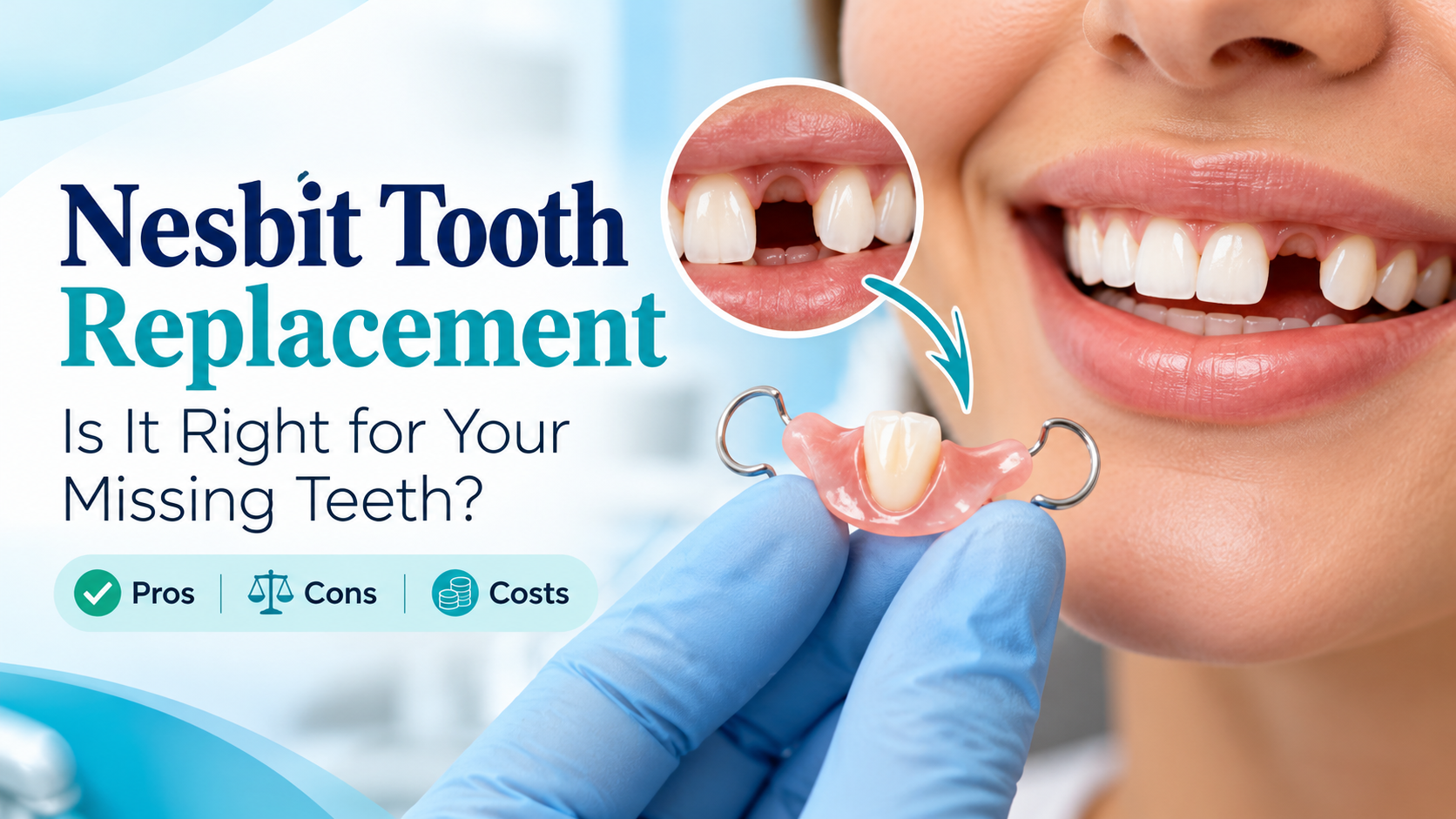
Missing a tooth can affect more than your smile. It may make chewing uncomfortable, change how you speak, and leave you wondering which replacement option is best for your needs. If you are missing a single tooth, a Nesbit dental appliance may be worth discussing with your dentist.
Nesbit tooth replacement is a type of removable partial denture designed to replace a small number of missing teeth, typically one tooth. It is usually compact, lightweight, and designed to fit around the remaining natural teeth.
But is a Nesbit appliance the right choice for you? The answer depends on where your tooth is missing, the health of your remaining teeth and gums, your budget, and whether you prefer a removable or fixed replacement.
This guide explains how Nesbit tooth replacement works, its benefits and limitations, and how it compares with dental implants and other tooth replacement options.
What Is Nesbit Tooth Replacement?
A Nesbit tooth replacement is a small, removable partial denture that replaces a missing tooth or, in some cases, a small number of teeth in a limited area. It consists of an artificial tooth attached to a supporting base or framework designed to fit around the surrounding oral structures.
Unlike a complete denture, which replaces an entire arch of teeth, a Nesbit appliance is intended for a more localized gap.
Depending on its design and materials, a Nesbit appliance may include:
- An artificial tooth that fills the visible gap.
- A lightweight base that supports the replacement tooth.
- Retentive components that help keep the appliance in position.
- A custom fit based on impressions or digital scans of your mouth.
Traditional Nesbit partial dentures have often used clasps or other retention features. Modern designs may use different materials and approaches, so the exact construction varies.
The main purpose of Nesbit tooth replacement is to restore a missing tooth with a compact, removable appliance without requiring a permanent surgical procedure.
How Does a Nesbit Dental Appliance Work?
A Nesbit appliance is custom-made to fit the space left by a missing tooth. Your dentist evaluates the gap, examines the surrounding teeth and gums, and determines whether the appliance can be designed to fit securely.
The process generally involves these steps:
- Dental examination: Your dentist checks the missing-tooth area, bite, gum health, and neighboring teeth.
- Impressions or digital scans: Measurements are taken to help create an appliance that fits your mouth.
- Appliance fabrication: A dental laboratory makes the replacement tooth and supporting structure.
- Fitting and adjustments: Your dentist checks comfort, stability, and how your teeth come together when you bite.
- Follow-up care: You receive instructions for inserting, removing, cleaning, and storing the appliance.
The appliance is removable, so you can take it out for cleaning according to your dentist's instructions.
Although a Nesbit appliance can restore the appearance of a missing tooth, it does not replace the natural tooth root. It also does not prevent all the changes that may occur in the jawbone after tooth loss.
Who Is a Good Candidate for Nesbit Tooth Replacement?
Nesbit tooth replacement may suit adults who want to replace a missing tooth without undergoing implant surgery or preparing neighboring teeth for a conventional dental bridge.
You may be a potential candidate if:
- You are missing one tooth or a small number of teeth in a limited area.
- You want a removable, relatively compact replacement.
- You prefer to avoid a surgical procedure.
- You need a temporary or alternative option while considering longer-term treatment.
- Your dentist determines that your remaining teeth and gums can support the appliance safely.
However, not everyone is a suitable candidate. The location of the missing tooth, your bite, the condition of neighboring teeth, and the appliance's stability all matter.
For example, replacing a missing front tooth may involve different cosmetic considerations than replacing a back tooth used for chewing. Similarly, an appliance that feels stable in one person's mouth may move or cause discomfort in another person's mouth.
A dental examination is necessary to determine whether a Nesbit appliance is appropriate and safe for your particular situation.
What Are the Benefits of Nesbit Tooth Replacement?
One reason people consider Nesbit tooth replacement is that it offers a relatively simple way to fill a tooth-sized gap.
1. A minimally invasive option
Unlike a dental implant, a conventional Nesbit appliance does not require surgery to place a replacement root in the jawbone.
This may appeal to people who want to avoid surgery or who are not ready for implant treatment.
2. Compact and lightweight design
Because the appliance replaces a limited number of teeth, it may feel less bulky than a larger removable partial denture. Comfort depends on the design, fit, and individual anatomy.
3. No need to permanently reshape neighboring teeth
A conventional dental bridge often requires the supporting teeth to be prepared to hold the restoration. A Nesbit appliance generally avoids this type of permanent tooth preparation.
4. Potentially lower initial cost
A Nesbit appliance may cost less upfront than a dental implant or some fixed restorations. However, actual costs depend on materials, laboratory fees, dental examinations, adjustments, and local pricing.
5. Removable for cleaning
You can remove the appliance for cleaning and inspect the surrounding teeth more easily than with some fixed restorations.
These advantages can make Nesbit tooth replacement an appealing option for selected patients. Nevertheless, a lower initial cost or simpler procedure does not automatically make it the best long-term solution.
What Are the Disadvantages of Nesbit Tooth Replacement?
Despite its benefits, a Nesbit appliance has limitations that you should understand before choosing it.
The biggest consideration is that a removable appliance may not provide the same stability, chewing efficiency, or long-term function as a well-planned fixed tooth replacement.
Potential disadvantages include:
- Movement during use: The appliance may shift while talking or chewing if retention is inadequate.
- A learning period: Some people need time to become comfortable inserting, removing, and wearing it.
- Maintenance requirements: The appliance must be cleaned regularly and checked for wear, damage, or changes in fit.
- Possible irritation: Poor fit or movement may irritate the gums or place unwanted pressure on supporting teeth.
- Limited protection against bone loss: Because it does not replace the tooth root, it does not prevent the normal bone changes associated with tooth loss.
- Safety considerations: Traditional single-tooth Nesbit designs may present a swallowing or aspiration risk if they become loose, particularly when worn in areas where retention is difficult to achieve.
That last point deserves special attention. A small removable appliance can be hazardous if it dislodges and enters the airway. Your dentist should assess retention and discuss whether another treatment would be safer for your circumstances.
Never continue wearing an appliance that repeatedly loosens, causes pain, or feels unstable without seeking dental advice.
Nesbit Tooth Replacement vs. Dental Implant vs. Dental Bridge
Choosing between a Nesbit appliance, dental implant, and dental bridge depends on your clinical needs, budget, preferences, and long-term goals.
|
Feature |
Nesbit appliance |
Dental implant |
Dental bridge |
|
Removable or fixed |
Removable |
Usually fixed |
Fixed |
|
Surgery required |
Generally no |
Usually yes |
No implant surgery |
|
Replaces tooth root |
No |
Yes, with an implant |
No |
|
Neighboring tooth preparation |
Generally not required |
Usually not required |
Often required |
|
Cleaning |
Removed for cleaning |
Cleaned in the mouth |
Requires cleaning around and beneath the bridge |
|
Initial cost |
Often lower |
Often higher |
Varies by design |
|
Bone preservation |
Does not prevent tooth-loss-related bone changes |
Can help maintain bone locally through functional loading |
Does not replace the root or reliably prevent bone loss beneath the missing tooth |
Which option is better for a single missing tooth?
Choose a Nesbit appliance when: You want a removable option, wish to avoid surgery, or need an alternative while considering other treatments, provided your dentist confirms it is safe.
Consider a dental implant when: You want a fixed replacement that functions independently of neighboring teeth and have suitable bone, gum health, and overall health for implant treatment.
Consider a dental bridge when: You prefer a fixed restoration and the neighboring teeth are suitable supports. A bridge may be especially worth discussing when adjacent teeth already need crowns.
No option is universally best. An implant may offer excellent long-term function for a suitable patient, but treatment time, surgery, bone requirements, and cost matter. A bridge avoids implant surgery but may require altering neighboring teeth. A Nesbit appliance avoids those procedures but requires removable-appliance care and may be less stable.
Your dentist can compare the options based on your specific mouth rather than relying on general advantages alone.
A Real-Life Example: When Might a Nesbit Appliance Make Sense?
Imagine someone who has lost a lower premolar and wants to fill the gap without immediately committing to implant surgery.
They work in an office, speak to clients regularly, and want a discreet replacement while they consider their long-term dental options. Their dentist examines the surrounding teeth and determines whether a removable appliance can fit securely without creating an unacceptable safety risk.
If the fit, retention, bite, and location are suitable, a Nesbit appliance may be one option to discuss. The patient can then compare its expected comfort, maintenance, and cost with those of an implant or bridge.
Now imagine that the same person has a history of the appliance becoming loose or has a bite that makes secure retention difficult. In that situation, the dentist may recommend a different restoration.
The lesson is that Nesbit tooth replacement is not simply a budget decision. Fit, retention, tooth location, and safety are equally important.
This is an illustrative example, not a report of an actual patient's treatment. Individual recommendations require an examination.
How Much Does Nesbit Tooth Replacement Cost?
The cost of Nesbit tooth replacement varies by location, dental practice, materials, laboratory fees, and the complexity of the case.
In general, a simple removable partial appliance may have a lower initial cost than implant treatment. However, the total cost can increase if you need examinations, diagnostic imaging, repairs, replacement appliances, or repeated adjustments.
Before choosing a treatment, ask your dentist for an itemized estimate that covers:
- The consultation and any necessary imaging.
- Appliance design and fabrication.
- Fitting appointments and adjustments.
- Future repair or replacement costs.
- Any additional treatment needed to maintain oral health.
It is also worth asking your dental insurance provider whether the appliance is covered and whether restrictions apply.
Rather than comparing only the initial price, consider how each option fits your budget, lifestyle, and expected maintenance needs over time.
How Do You Care for a Nesbit Dental Appliance?
Good care helps keep your appliance clean, comfortable, and functional.
Follow these basic guidelines:
- Clean it daily: Use a cleaning method and product recommended for your appliance's material.
- Clean your natural teeth: Brush twice daily with fluoride toothpaste and clean between your teeth.
- Handle it carefully: Avoid bending clasps or forcing the appliance into place.
- Store it properly: Follow your dentist's instructions for storage when it is not being worn.
- Attend dental checkups: Have the fit, supporting teeth, gums, and bite checked regularly.
- Report changes promptly: Seek an adjustment if the appliance becomes loose, painful, cracked, or difficult to insert.
Do not use hot or boiling water unless specifically instructed, as heat can damage some denture materials. Avoid household adhesives and do not attempt to repair a broken appliance yourself.
Ask your dentist whether you should wear the appliance while sleeping. Recommendations can vary depending on its design, retention, and your individual needs.
Is Nesbit Tooth Replacement Right for You?
Nesbit tooth replacement can be a useful option for selected people who need to replace a missing tooth with a small, removable appliance. It may be attractive because it can avoid implant surgery, usually does not require permanent preparation of neighboring teeth, and may have a lower initial cost.
However, it is not suitable for every missing tooth. Retention, comfort, chewing demands, the risk of dislodgement, and the condition of the surrounding teeth all influence whether it is a sensible choice.
Before deciding, ask your dentist these questions:
- Is a Nesbit appliance safe for the location of my missing tooth?
- How securely will it stay in place when I talk and chew?
- Would an implant, bridge, or another partial denture offer better results?
- What are the initial and long-term costs of each option?
- How often will the appliance need adjustments or replacement?
The bottom line: Nesbit tooth replacement may be right for you if you want a compact, removable solution and your dentist confirms that it can be retained safely. The best choice is the one that balances appearance, comfort, oral health, safety, and long-term value.