Nesbit Partial Denture: Complete Guide to Cost, Fit & Materials
A missing tooth can affect more than
your smile. It can make chewing uncomfortable, change how your teeth meet, and
leave you searching for a replacement that feels natural without committing to
a permanent procedure.
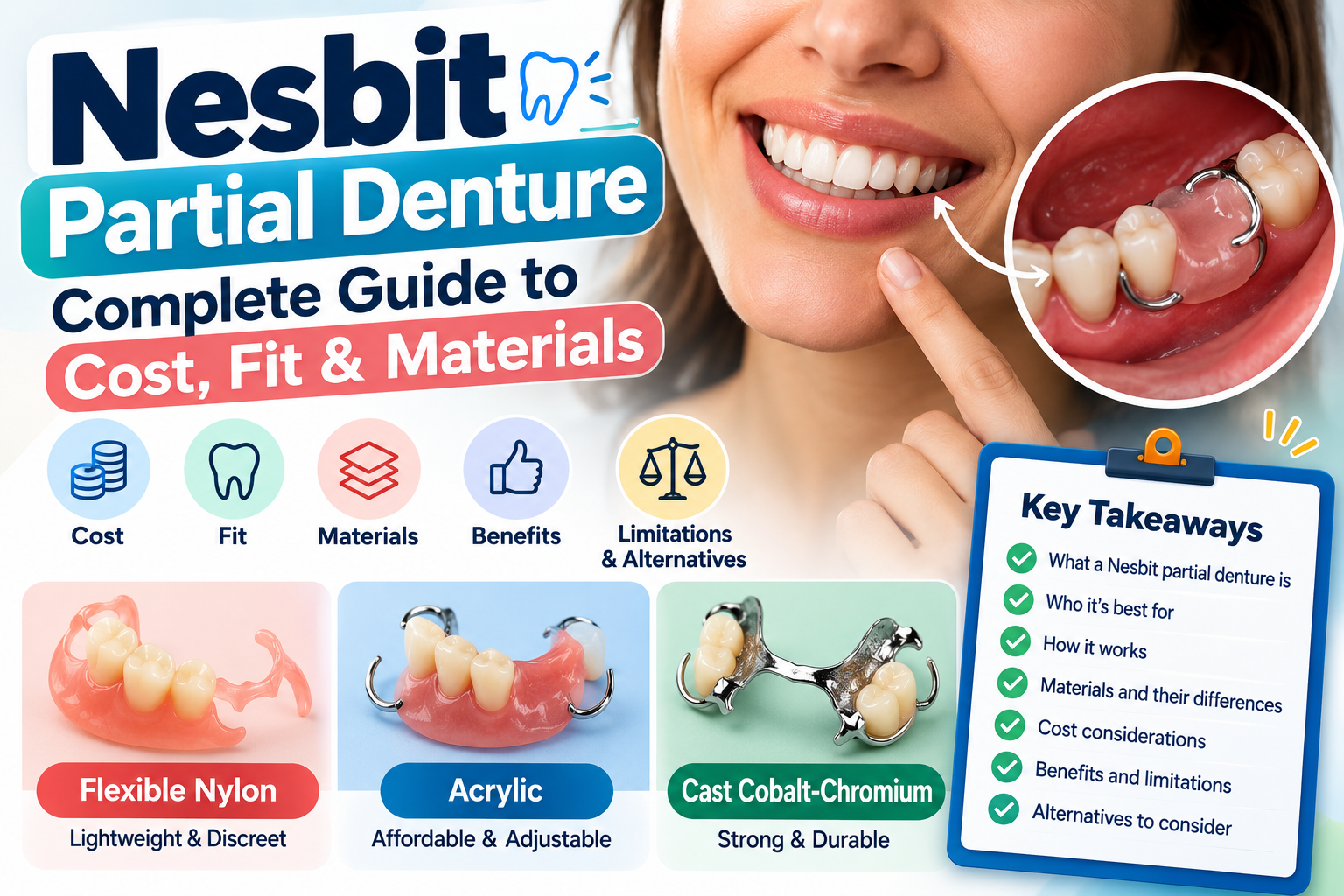
A Nesbit partial denture is
one option for replacing a small number of missing teeth on one side of the
mouth. It is a removable, unilateral partial denture designed to stay
relatively compact rather than extending across the entire dental arch.
But is a Nesbit partial right for
you? The answer depends on the location of the missing tooth, the health of the
neighboring teeth, the material used, your budget, and how you expect the
appliance to perform.
Here is what you should know about Nesbit
partial dentures, including cost, fit, materials, benefits, limitations, and
alternatives.
What Is a Nesbit Partial Denture?
A Nesbit partial denture is a
small removable dental appliance designed to replace one or a few missing teeth
on one side of the mouth.
Unlike many conventional partial
dentures, a Nesbit typically does not need to span the entire dental arch.
A typical Nesbit partial may
include:
- One or two artificial teeth
- A gum-colored base or framework
- Clasps or retentive elements
- A design customized to the patient's remaining teeth
The exact design depends on the
patient's mouth and the material selected.
Who Is a Nesbit Partial Best For?
A Nesbit partial is generally considered
when a patient has a small tooth gap on one side of the mouth,
particularly when only one or two teeth need replacement.
For example, imagine a patient named
Mark who lost one lower molar. He does not want an implant immediately and does
not need a large partial denture to replace several teeth.
A small unilateral appliance may be
considered as one possible solution after a dental evaluation.
However, not every missing tooth is
automatically suitable for a Nesbit. The dentist needs to evaluate the surrounding
teeth, gums, bite, available support, and how securely the appliance can be
retained.
How Does a Nesbit Partial Denture Work?
A Nesbit partial uses the teeth and
oral structures around the missing-tooth area for support and retention.
The replacement tooth sits in the
space created by the missing tooth, while the appliance uses clasps or another
retention mechanism to help keep it in position.
The goal is to create an appliance
that:
- Replaces the visible missing tooth.
- Provides functional chewing support.
- Fits securely around the remaining teeth.
- Feels reasonably comfortable during normal use.
- Looks as natural as practical.
Because a Nesbit is relatively
small, fit is especially important. A loose unilateral appliance can
move during chewing or speaking and should be professionally evaluated rather
than simply worn through discomfort.
What Materials Are Used for a Nesbit Partial?
Nesbit partial dentures can be made
using different materials. The most common choices include flexible nylon,
acrylic, and cast cobalt-chromium metal.
The material affects the appliance's
appearance, rigidity, comfort, durability, adjustability, and price.
1. Flexible Nylon
Flexible Nesbit dentures use a
thermoplastic, gum-colored material that can flex around supporting teeth.
This design is popular with patients
who want to avoid visible metal clasps. Flexible materials can provide a
lightweight and discreet appearance, although they can be more difficult to
adjust or reline than traditional acrylic designs.
Potential advantages:
- Metal-free appearance
- Lightweight design
- Gum-colored appearance
- Flexible retention
- Often aesthetically appealing
Potential limitations:
- More difficult to modify
- May not be ideal for every bite
- Retention depends heavily on proper design
- Replacement may eventually be needed if the fit changes
2. Acrylic
Acrylic is another option for
partial dentures. It is generally more affordable and can be relatively
straightforward to adjust.
However, acrylic appliances can be
bulkier than cast-metal designs and may be more susceptible to fracture depending
on their design and use.
Acrylic may make sense when
affordability or adjustability is an important consideration.
3. Cast Cobalt-Chromium
Cast cobalt-chromium is a rigid
metal alloy commonly used for durable removable partial denture frameworks.
It can be made relatively thin while
providing strong support and retention. However, metal components may be more
noticeable depending on where the appliance is positioned.
This option may be considered when
stability and long-term durability are higher priorities.
Nesbit Partial: Flexible vs Acrylic vs Metal
Choosing the material is not simply
about finding the cheapest option. It is about balancing fit, appearance,
strength, comfort, and long-term use.
|
Feature |
Flexible Nylon |
Acrylic |
Cast Cobalt-Chromium |
|
Appearance |
Very discreet |
Good |
May show metal |
|
Flexibility |
High |
Low |
Low |
|
Rigidity |
Lower |
Moderate |
High |
|
Comfort |
Often lightweight |
Can feel bulkier |
Usually slim |
|
Adjustability |
More difficult |
Easier |
Requires professional adjustment |
|
Durability |
Good |
Moderate |
High |
|
Metal-free |
Sí |
Usually |
No |
|
Typical use |
Aesthetic/small-gap cases |
Budget/interim cases |
Stability and long-term use |
There
is no universal "best" material. The ideal choice depends on your
dental anatomy and the goals of treatment.
How Much Does a Nesbit Partial Denture Cost?
The cost of a Nesbit partial
denture varies significantly depending on the material, laboratory,
dentist, geographic location, design complexity, consultations, impressions,
adjustments, and whether additional dental treatment is needed.
Published examples illustrate how
wide the pricing range can be. One U.S. dental laboratory currently lists a
Nesbit starting around $399, while other sources describe substantially
higher dental-office costs.
What
Can Increase the Cost?
Your final price may be affected by:
- Number of teeth being replaced
- Flexible vs. acrylic vs. metal construction
- Dental examination and consultation
- Impressions or digital scans
- Laboratory fabrication
- Tooth preparation
- Additional dental treatment
- Adjustments after delivery
- Remaking or replacing an old appliance
Important: A very low advertised price may not include examination,
impressions, adjustments, or other necessary dental services.
Does a Nesbit Partial Fit Comfortably?
A properly designed Nesbit can be
comfortable, but comfort depends heavily on fit and retention.
The appliance should not constantly
rub the gums, create persistent sore spots, or move significantly while you eat
or speak.
Some initial awareness is normal
when adapting to a removable dental appliance. Persistent pain, looseness, or
irritation, however, is a reason to have the fit checked.
Signs Your Nesbit May Need Adjustment
Watch for:
- Persistent gum soreness
- Repeated slipping
- Difficulty chewing
- Pain when biting
- Irritation around supporting teeth
- Difficulty speaking after the adjustment period
- A noticeable change in how your teeth come together
Don't try to permanently reshape the
appliance yourself. Professional adjustment is safer and more predictable.
Real-Life Example: Choosing a Nesbit for One Missing Tooth
Consider Sarah, who has lost one
premolar on the right side of her mouth.
She wants to replace the tooth but
isn't ready for an implant. She also doesn't want a large partial denture
covering areas of her mouth that don't need replacement.
Her dentist evaluates the
neighboring teeth and bite and determines that a small removable appliance may
be appropriate.
Sarah then compares flexible and
acrylic options. She prefers the discreet appearance of a flexible material,
while another patient might prioritize the easier adjustability or lower
initial cost of acrylic.
The important point is that the best
choice isn't determined by price alone.
The fit and design need to work with the patient's individual mouth.
Nesbit Partial vs. Flipper: What's the Difference?
A Nesbit partial and a dental
flipper are both removable tooth-replacement options, but they aren't
necessarily designed in the same way.
A flipper is generally a lightweight
acrylic partial often used as an economical or temporary replacement, while a
Nesbit is specifically a unilateral design intended for a smaller area on one
side of the mouth.
Nesbit
- Small unilateral design
- Often used for one or two missing teeth
- Can be flexible, acrylic, or metal depending on design
- Designed around the specific missing-tooth area
Flipper
- Usually acrylic
- Can replace one or several teeth
- Often used as a temporary or economical option
- May cover more of the dental arch
So, Nesbit vs. flipper isn't
simply a matter of which one is better. The appropriate choice depends on
the number and location of missing teeth and the desired treatment outcome.
What Are the Benefits of a Nesbit Partial?
A Nesbit partial can offer several
practical advantages for appropriately selected patients.
Smaller
Design
Because it is designed for one side
of the mouth, it can be less extensive than a conventional full-arch partial.
Removable
You can remove the appliance for
cleaning and maintenance.
Non-Surgical
Unlike an implant, a removable
partial does not require implant placement surgery.
Potentially
More Affordable
Depending on the material and
provider, a removable partial may have a lower initial cost than some permanent
tooth-replacement options.
Discreet
Options Available
Flexible gum-colored materials can
reduce the visibility of metal components.
What Are the Limitations of a Nesbit Partial?
A Nesbit isn't the perfect solution
for every patient.
Potential limitations include:
- It is removable rather than permanently fixed.
- The appliance can become loose if the fit changes.
- Some materials are difficult to repair or reline.
- Supporting teeth need to be evaluated.
- A unilateral appliance requires careful attention to
retention and stability.
- It may not be appropriate for larger or more complex
tooth-loss patterns.
Because the design is concentrated
on one side, professional evaluation is particularly important when
deciding whether it will provide sufficient stability.
How Long Does a Nesbit Partial Last?
There is no single guaranteed
lifespan for a Nesbit partial.
Its longevity depends on:
- Material
- Bite forces
- Oral hygiene
- Appliance design
- Changes in the gums and bone
- Condition of supporting teeth
- How carefully it is handled
- Regular professional maintenance
A denture that becomes loose should
not simply be worn indefinitely. Changes in the mouth can affect how an
appliance fits over time.
How Do You Care for a Nesbit Partial?
Proper maintenance can help keep
your appliance clean and comfortable.
Follow these basic habits:
- Remove and clean it according to your dentist's
instructions.
- Rinse it after meals when appropriate.
- Clean your natural teeth carefully.
- Keep the appliance in its recommended storage solution
when not being worn.
- Avoid very hot water that could affect certain
materials.
- Handle the appliance carefully because its small size
makes it easy to drop or misplace.
- Attend dental checkups to monitor the supporting teeth
and fit.
Because material specifications differ,
follow the cleaning instructions provided for your particular Nesbit.
Is a Nesbit Partial Right for You?
A Nesbit partial can be an
attractive option when you need to replace a small number of missing teeth
on one side of your mouth and want a removable solution.
It may be worth discussing if you
are looking for:
- A compact removable denture
- A replacement for one or two missing teeth
- A non-surgical option
- A potentially more affordable alternative to some
permanent treatments
- A discreet tooth-replacement solution
However, your dentist should
evaluate your teeth, gums, bite, and overall oral condition before deciding
whether a Nesbit is appropriate.
Final Takeaway
A Nesbit partial denture is a
compact, removable solution designed primarily for replacing a small number of
missing teeth on one side of the mouth. Its biggest advantages can include its
small size, removability, and availability in different materials.
The right choice ultimately comes
down to fit, retention, material, aesthetics, durability, and cost.
If you're comparing flexible, acrylic, and metal Nesbit options, don't choose based on appearance or price alone. A properly designed appliance should work with your existing teeth and bite while providing a secure and comfortable fit.