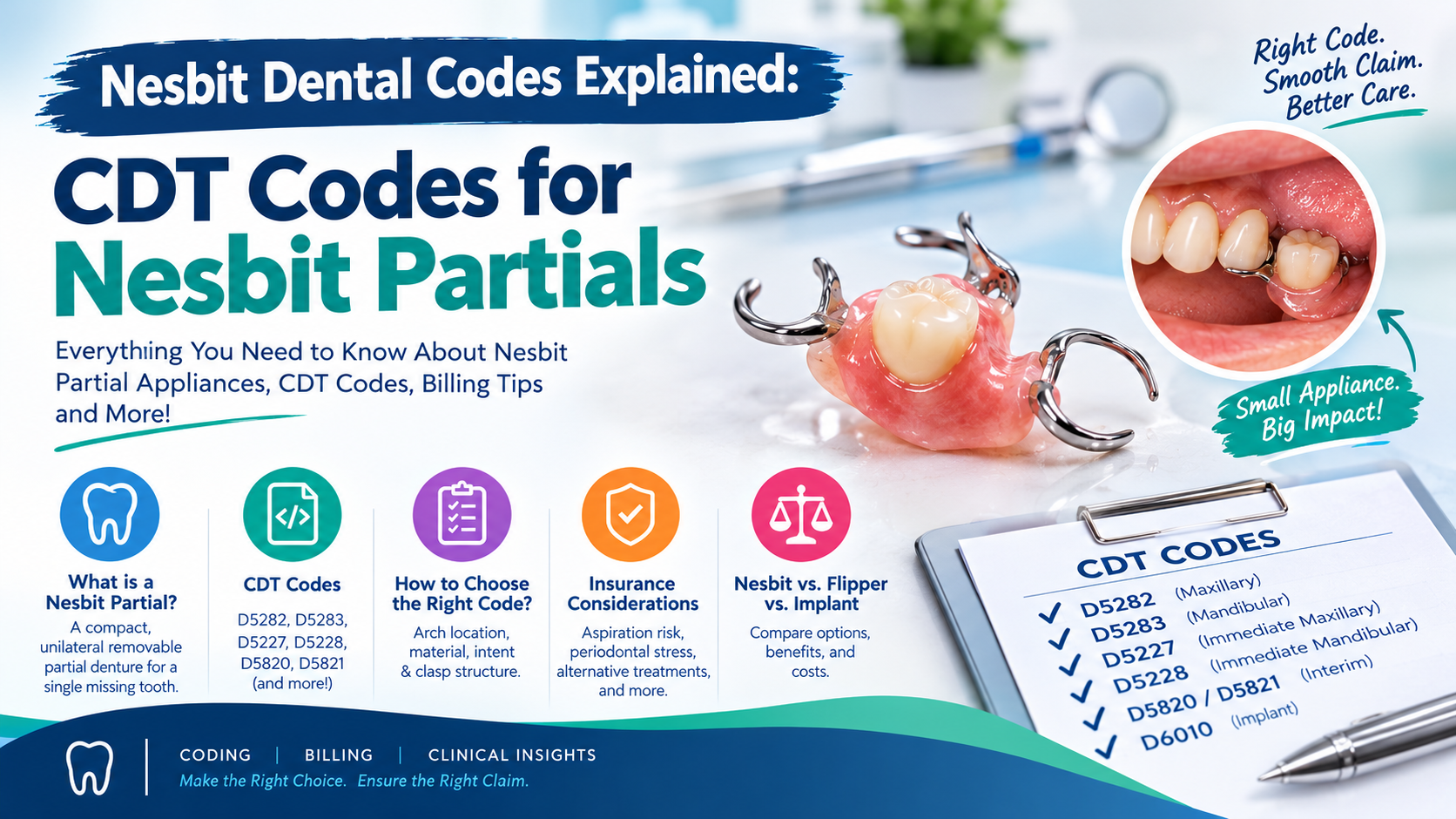
What Is a Nesbit Partial Appliance in Dentistry?
A Nesbit partial (often referred to simply as a Nesbit) is a small, removable dental prosthesis designed to replace a single missing tooth on one side of the mouth (unilateral). Unlike full partial dentures that span across both sides of the arch and rest on the palate or floor of the mouth, a Nesbit is compact and relies strictly on adjacent natural teeth for retention and support.
Key Features of a Nesbit Partial
- Unilateral Design: It fits exclusively on either the left or right side of the upper or lower arch.
- Single-Tooth Replacement: It replaces one missing tooth without extending across the entire mouth.
- Clasp Retention: It uses metal, tissue-colored, or clear clasps that wrap around adjacent natural teeth.
- Minimalist Footprint: It covers a tiny surface area compared to traditional cast-framework removable partial dentures (RPDs).
Which Primary CDT Code Is Used for a Nesbit Partial?
The primary Current Dental Terminology (CDT) code used when billing for a single-tooth, unilateral removable partial denture is D5282 or D5283.
Standard CDT Codes for Unilateral Partial Dentures
- D5282: Removable unilateral partial denture, one piece flexible base (including clasps and teeth) – maxillary (upper arch).
- D5283: Removable unilateral partial denture, one piece flexible base (including clasps and teeth) – mandibular (lower arch).
- D5227: Immediate removable unilateral partial denture, one piece flexible base (including clasps and teeth) – maxillary.
- D5228: Immediate removable unilateral partial denture, one piece flexible base (including clasps and teeth) – mandibular.
- D5820 / D5821: Interim partial denture (stayplate/flipper) – maxillary or mandibular (often used if the unilateral appliance is temporary).
How Do You Select the Correct Nesbit Dental Code for Billing?
Choosing the correct nesbit dental code depends on three main factors: arch location, material composition, and whether the appliance is permanent or provisional.
Step-by-Step CDT Selection Checklist
- Determine the Arch Location:
- Upper arch = Maxillary
- Lower arch = Mandibular
- Identify the Appliance Material:
- Flexible resin base (e.g., Valplast, TCS, Sunflex) vs. cast metal framework vs. acrylic stayplate.
- Determine the Intent & Timing:
- Is it a definitive long-term prosthesis, an immediate post-extraction appliance, or a temporary interim flipper?
- Verify Clasp Structure:
- Are clasps integrated into the base framework or added separately?
Why Is the Nesbit Dental Code Often Scrutinized by Insurance Payers?
Dental insurance carriers examine Nesbit claims closely because unilateral appliances carry specific clinical risks, primarily swallowing or aspiration hazards due to their small size.
Primary Reasons for Insurance Review
- Aspiration and Ingestion Risk: Because a Nesbit is small, an unseated or loose appliance can present a choking or swallowing hazard if it becomes dislodged during eating or sleep.
- Periodontal and Abutment Stress: Unilateral partials place heavy torque loads on only one or two abutment teeth, which can cause bone loss or tooth mobility over time.
- Alternative Treatments: Insurers frequently consider dental implants (D6010) or fixed partial dentures/bridges (D6200 series) as the standard of care for single-tooth replacement.
- Medical Necessity Verification: Documentation must demonstrate why a full bilateral RPD, bridge, or implant was not suitable for the patient.
How Does a Nesbit Compare to a Flipper Denture vs. a Dental Implant?
When replacing a single missing tooth, dental professionals and patients evaluate three common options: a Nesbit partial, a acrylic flipper, and a dental implant.
Comparison: Nesbit vs. Flipper vs. Dental Implant
|
Feature |
Nesbit Partial |
Acrylic Flipper (D5820/D5821) |
Dental Implant (D6010) |
|
Arch Coverage |
Unilateral (one side only) |
Palatal/lingual cross-arch coverage |
Fixed into jawbone (no arch coverage) |
|
Primary CDT Code |
D5282 / D5283 |
D5820 / D5821 |
D6010 + D6057 + D6058 |
|
Aspiration Risk |
Higher (small size) |
Lower (broader coverage) |
None (fixed, non-removable) |
|
Comfort & Bulk |
Very low bulk, highly localized |
Bulkier, covers palate/floor |
Functions like a natural tooth |
|
Longevity |
Medium (Interim to semi-permanent) |
Short (temporary/provisional) |
Long-term (15+ years) |
|
Cost Level |
Moderate |
Low |
High |
What Real-Life Clinical Scenario Demonstrates Correct Nesbit Billing?
To understand how nesbit dental code selection works in a busy practice, consider this real-world patient scenario.
Case Study: Single-Tooth Replacement Post-Extraction
Patient Background:
Sarah, a 42-year-old patient, had tooth #19 (lower left first molar) extracted due to a non-restorable root fracture. She wants to replace the missing tooth for masticatory comfort but cannot afford a dental implant at this time and declines a traditional three-unit fixed bridge. She requests a minimal, removable option that does not cover her entire palate or tongue floor.
Clinical Workflow & Billing:
- Diagnosis & Treatment Plan: The dentist presents options and selects a single-piece flexible unilateral lower partial appliance replacing tooth #19.
- Procedure Execution: Impressions and bite registrations are taken. The lab fabricates a flexible, tissue-shaded unilateral appliance with flexible clasps on teeth #18 and #20.
- Coding & Submission:
- CDT Code Claimed: D5283 (Removable unilateral partial denture, one piece flexible base – mandibular).
- Supporting Documentation: Intraoral photographs showing abutment integrity, clinical narrative explaining why a bilateral denture was contraindicated due to severe bilateral tori, and a signed patient consent acknowledging the unilateral appliance care instructions.
- Outcome: The claim is processed cleanly without rejections because the material type, arch placement, and narrative clearly justified code D5283.
Which Additional CDT Codes Are Frequently Billed alongside a Nesbit?
When fabricating, delivering, or maintaining a Nesbit partial, several related procedures may be billed alongside the primary nesbit dental code.
Common Companion CDT Codes
- D0140: Limited oral evaluation – problem focused.
- D0220 / D0230: Intraoral periapical radiographs (first film and additional films).
- D4341 / D4342: Periodontal scaling and root planing (to ensure abutment teeth are periodontally stable prior to seating).
- D5421 / D5422: Adjust partial denture – maxillary / mandibular (billed for adjustments performed after the initial post-delivery period).
- D5611 / D5612: Repair flexible base – maxillary / mandibular.
- D5630: Repair or replace broken clasp.
How Can Dental Practices Prevent Narrative Denials for Nesbit Claims?
Submitting a claim with a nesbit dental code without proper documentation often leads to requests for additional information or outright denials.
Best Practices for Clean Claim Submission
- Include Pre-Operative Radiographs: Submit recent periapical X-rays demonstrating that the abutment teeth have adequate bone support and zero mobility.
- Attach Intraoral Photos: Clearly highlight the missing tooth space and adjacent anchor teeth.
- Draft a Precise Narrative: Explain the clinical rationale for choosing a unilateral flexible denture over a bilateral partial or fixed prosthesis.
- Verify Patient Medical History: Document any physical or anatomical conditions (such as severe palatal tori, gag reflex issues, or financial constraints) that ruled out alternative full-coverage appliances.
- Record Delivery Consent: Ensure the clinical notes reflect that the patient was educated on proper cleaning, seating, and safe sleep habits to prevent accidental swallowing.
Ready to Streamline Your Dental Billing & Maximize Reimbursements?
Navigating CDT coding nuances and medical necessity narratives shouldn't hold back your practice's revenue cycle. Whether you need pre-written narrative templates for complex claims or expert advice on reducing claim denials, our dental billing specialists are here to help.
[Schedulea Free Dental Billing Audit Today] to ensure your practice gets paid faster and with fewer rejections!